Jihad and the Legacy of St. Patrick
Did you know that the work of St. Patrick in Ireland may have led to stopping the first Islamic invasion of Europe?
When most people think about St. Patrick, what comes to mind is shamrocks, the wearin’ of the green, and driving the snakes from Ireland.
The historical St. Patrick was much more than that. Born in Britain to a wealthy family in the waning days of the Roman Empire, Patrick was captured at age 16 during a pirate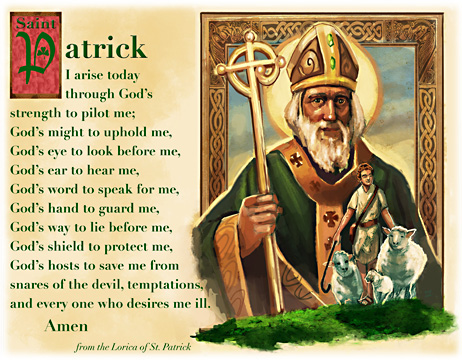 raid. He was torn from his family and taken in chains to Ireland. There he was sold as a slave.
For six years, he herded sheep and began to seek after God. His faith grew as he sought solace from the oppression of slavery. One night he heard a voice in a dream telling him to escape to the coast. He followed this counsel and was able to find passage on a ship. After a roundabout journey, he was able to return to England and his family.
One night he had another dream. As he slept, a man named Victorius appeared to him and handed him a letter called “The Voice of the Irish”. As Patrick read the letter, it seemed as if he was hearing the voices of the Irish people saying “we beg of you holy youth to return and walk among us again.”
As a result of the dream, Patrick felt a calling to reach the people of Ireland with the Gospel. He studied for the priesthood and eventually became a bishop.
In 433, Patrick returned to Ireland. He began to preach the Gospel to the Irish people, and whole kingdoms in Ireland began to turn to Christ. Thousands accepted Christ as result of his ministry. Many monasteries were also formed in Ireland.
Around the time that St. Patrick died, in 461, so did the Roman Empire. Europe was overrun by barbarian tribes with no regard for Christianity or the written word. Ireland alone in Europe was unaffected by the collapse of Roman power. It had never been part of the Roman Empire, and was not invaded by the hordes that ran roughshod over the continent.
In the century after St. Patrick died, Irish monks, led by a man named Columbanus, began to go to the continent as missionaries. They formed monasteries throughout mainland Europe. They led the people to Christ. They preserved the writings of Christianity as well as other historical books. Thomas Cahill, in his excellent book How the Irish Saved Civilization, wrote that without the work of Irish monks in Europe, Western Civilization may have been completely lost. It was those monks from Ireland that preserved faith and literacy in the post-Roman world. They led the way in forging a common identity for Europe, a Christian identity. For many centuries afterward, continuing through the Middle Ages, Europe was commonly referred to as Christendom.
In the early 700s, Muslim armies from North Africa invaded Spain and pushed northward into France. Starting in Syria in 632, and waging war across North Africa, the followers of Muhummad had been conquering Christian lands for a century. They made it as far north as the city of Tours, 100 miles from Paris, before running into an army led by Charles the Hammer, the grandfather of Charlemagne. Charles and his army did what no other force had been able to do for 100 years; halt the continued Islamic conquests.
The Battle of Tours in 732 is one of the most important in history. Outnumbered over 2 to 1 by some estimates, the army of Charles the Hammer held their ground and routed their enemies. It marked the end of Islamic expansion in Europe. What made this possible? Why did they succeed where others had failed? Unlike in other regions where Muslim armies had prevailed, in Europe they faced a people united against them. A people who saw the threat of Islamic invasion for what it was. A people that were concerned about their faith and knew that at best Christians in Muslim dominated lands were treated as dhimmi, second class citizens that paid a religious tax.
From that point on, Muslim forces were only in retreat in Europe for the next 7 centuries.
Today the continent once known as Christendom has lost its Christian identity and is once again vulnerable to Islamist invasion.
As Europe faces a renewed threat of jihad today, there is much to be learned from the example of St. Patrick.
If you want to read more about the history of religious freedom, check out my historical novel Taking the Cross. It is about the beginnings of religious freedom movements.
Posted in Uncategorizedwith no comments yet.
Threats to Religious Freedom in America and the Statue of Liberty
Last summer my family and I went on vacation to New York City. One of the things we wanted to see in New York was the Statue of Liberty. We love to go to places that symbolize freedom. Our passion is to see people live in freedom.
It is no secret that there is a concerted attempt to marginalize and destroy religious freedom in America. In the next months and years we are going to find out the true  strength of religious freedom in the US. Do we want to know the answer?
I took this picture from the Staten Island Ferry. Sometimes you hear so much about a place, that you think you know it already. The Statue of Liberty is such a common symbol, we don’t often think about its meaning. Many people see Lady Liberty from the ferry but don’t visit her up close. But last year I learned something about her that relates to religious freedom in America. I believe it’s a truth we desperately need to realize.
 The Statue of Liberty is one of the greatest symbols of freedom in the world. During the height of immigration to the US, during the early 20th century, over 1 million people a year passed by the Statue of Liberty on their way to Ellis Island, seeking freedom from oppression in other nations.
When we visited the Statue of Liberty, we went through the museum that is in the massive pedestal that supports the statue itself. Many of the exhibits talk about the strength of the statue and the foundation on which it is built. You can see that in the picture above. The Statue of Liberty is built to withstand even the fiercest storms. One of the exhibits said that the statue is so strong, and it is anchored so deeply in the bedrock of Liberty Island, that you would have to overturn the entire island to take down the statue. In other words, to destroy Lady Liberty, you would have to destroy her foundation.
400 years ago, people started coming to America seeking religious freedom. They have been coming ever since for that same reason. People come to America for freedom.
Without religious freedom all other freedoms are diminished. Without religious freedom, there will eventually be no freedom in America. Those who view religious freedom as a threat to their own freedoms are incredibly shortsighted. They are entirely ignorant of why we have freedom in America in the first place. In other places in the world that are oppressive, religious freedom is typically public enemy number one.
It has been breathtaking to hear so many in this country openly talk about squelching not only freedom of religion, but freedom of speech. We hear this on college campuses and increasingly throughout the media and from places like the U.S. Commission on Civil Rights, which has stated in effect that religious freedom is less than the “rights” of men to use women’s restrooms and gay couples to force a Christian baker to help them celebrate their union. In this light, religious freedom is seen not as freedom at all, but merely a cover for oppression and discrimination. So-called “rights” that have been invented in our generation are now seen as taking precedence over beliefs that have been deeply held not for centuries, but for millenia.
It is not a stretch to say that America is built upon the foundation of religious freedom. The battle cry during the Revolutionary War, when faced with an oppressive King of England, was “no king but King Jesus”.
Those who attack and seek to marginalize religious freedom attack their own freedom. They often think they can do away with freedom of religion and other freedoms, like freedom of speech, as long as their own beliefs reign supreme. This is what is happening on many college campuses. The shortsightedness of such thinking is spectacular. They are like Samson in the Bible, who pushed down the columns in the Philistine temple to destroy his enemies. The only problem is that he was killed at the same time they were. Samson knew he would die along with his enemies, but those seeking to destroy religious freedom are completely ignorant of what they are doing.
Now is no time to panic or be afraid, but to stand firm in joy. To celebrate our freedom of religion and the many blessings we have in America. Celebrate them lest they wither away from disuse. Paul wrote in the Book of Ephesians to “put on the full armor of God, so that when the day of evil comes, you may be able to stand your ground, and after you have done everything, to stand.” We must stand firm.
It was Christians that were behind the abolition movement, it was Christians that were behind the civil rights movement. Today it is Christians that are driving the movement to end human trafficking.
American exceptionalism begins and ends with religious freedom. It is deeply anchored in the foundation of this country.
To seek to destroy religious freedom in America is to seek to completely overturn the country. If you want to destroy religious freedom, you will have to destroy America herself.
And then you will have no freedom.
But I believe that America will not be so easily overturned. Freedom of religion will not be so easily squelched.
But even if it is, there is a deeper foundation that will never be overturned. It is on that rock we need to stand and cry “no king but King Jesus!”
If you want to read more about the history of religious freedom, check out my historical novel Taking the Cross. It is about the beginnings of religious freedom movements.
Posted in Uncategorizedwith no comments yet.
The Story Behind Valentine’s Day
If you thought Valentine’s Day was just a commercial holiday created by Hallmark in league with florists and jewelry stores, think again.
It may be largely celebrated that way now, but that’s not how it started.
Valentine was a priest who lived in Rome in the 3rd century. The Roman emperor at the time was the brutal Claudius II. Having a difficult time recruiting men to join the Roman legions, Claudius concluded that it was because the men were too devoted to their wives and children. The Emperor Claudius’s “solution” to this dilemma was to ban all marriages and engagements in Rome.
Great idea.
Knowing the decree was wrong and believing that he had to serve God rather than man, Valentine began marrying couples in secret. Though it is  unknown how many couples he married, eventually he was found out and arrested. He was turned over to the Prefect of Rome where he was thrown in jail.
The emperor, who was also called Claudius the Cruel, demanded that Valentine be executed. The means of death, which certainly would qualify as cruel and unusual punishment today, at least in the United States and in modern Rome, was being beaten with clubs. After he died from all the blows, he was beheaded.
The date of his death was February 14, 278. Though there are disputes about the year, the actual calendar day seems to be largely agreed upon.
There is a legend that states that just before his execution, Valentine composed a note to the jailer’s daughter telling her goodbye. In it he wrote “From your Valentine.”
This story casts a much different light on love than we often see celebrated on Valentine’s Day. Where is cupid anyway? Instead of some little guy flying around in a diaper and shooting people with a bow and arrow, we have a servant of God who risked his life to join couples together in secret before God.
Greater love has no one than this, that he lay down his life for another.
Valentine believed that marriage between a man and a woman, and the covenant with God it represents, was worth dying for. Do we believe the same today?
The idea of romance as we know it now, did not start until the Middle Ages and the troubadours in France. But that is for another blog post…
If you want to read more about the time of the troubadours, check out my historical novel Taking the Cross.
Posted in Uncategorizedwith no comments yet.
Amazing Grace and the Slave Trade – The Story Behind the Song
Amazing Grace might be the most popular song ever written. But do you know the story behind it?
When the author wrote “Amazing Grace how sweet the sound that saved a wretch like me” why did he call himself a wretch? Is it exaggeration  or hyperbole as some have suggested? To Englishman John Newton, who wrote Amazing Grace, it was no exaggeration. Newton was the 18th century captain of a slave ship who transported upwards of 20,000 kidnapped Africans to slavery in the West Indies.
John Newton’s experience at sea began with his father, who was captain of a merchant ship. The younger Newton went on six voyages with his father. When he was 19, Newton was pressed into service aboard a British naval ship. It was a common practice in the 18th century that essentially involved kidnapping young men and forcing them to serve on a ship for at least 2 years. Newton found the conditions on ship so horrible that he deserted. He was recaptured, publicly flogged, and demoted.
He asked to serve on a slave ship instead. Newton ended up serving under a slaver that was horribly abusive. A man who not only beat the slaves he was transporting to the West Indies, but regularly abused Newton as well. A ship captain who was a friend of John’s own father rescued him from that experience.
John Newton eventually became captain of his own slave ship. After his harsh treatment at the hands of a slaver, it is a wonder he wanted to become one himself. Yet in the 18th century, the slave trade was a huge portion of the British economy. On one journey, when he was returning home after delivering a ship full of slaves to the West Indies, he became caught in a violent storm that threatened to sink the boat. In a moment of desperation, he cried out to God. Newton saw his subsequent survival as the first experience of grace in his life. He later referred to the event as his “great deliverance”.
 After becoming a Christian, Newton’s first step as a slave ship captain was to treat the men and women he transported more humanely. But he soon realized that no matter how well he treated the Africans on his ship, they were still kidnapped people that he was transporting to a life of misery. He abandoned the slave trade altogether and sought to become a pastor. He also started writing hymns.
It took several years, but he eventually became pastor of his own church. His preaching was so popular that the church had to be remodeled to accommodate all those who wanted to hear him. In spite of this, he still continued to be haunted by what he called his “20,000 ghosts”, the men, women, and children he had brought to slavery in the West Indies. It was during this time, in the late 1770s, that he penned Amazing Grace. It was first released as part of a hymnal that was published in 1779.
One of the people in Newton’s church congregation was a boy named William Wilberforce. When Wilberforce became a member of Parliament in his 20s, Wilberforce went to Newton to seek his advice. Wilberforce had recently found a renewed faith in God and was considering leaving Parliament to become a pastor himself. Newton encouraged Wilberforce to stay in Parliament and seek the abolition of the slave trade.
Wilberforce, who had already considered taking on the fight against slavery, followed Newton’s advice, and eventually became the leader of the abolition movement in England. It took 25 years and multiple setbacks, but the British slave trade was finally abolished in February, 1807, only months before John Newton died. Newton himself, nearly blind and in failing health, was present when the vote was taken in Parliament that outlawed the slave trade that had once been his livelihood. Newton wrote extensively about the slave trade, and his writings are the major source of information we have today about the brutal practice of trafficking in human souls.
The British Slave Trade was outlawed, and shortly afterward the slave trade was abolished in America and France as well. By about 1810, hauling people from Africa to the New World as slaves was truly brought to an end.
William Wilberforce continued to fight for the complete abolition of slavery itself throughout the British empire. It happened in 1833, only 3 days before Wilberforce died. When Abraham Lincoln chose to fight against slavery in the United States, his major inspiration was William Wilberforce.
Yet the trafficking in human souls endures. Slavery has gone underground, but it is more prevalent than ever. It is estimated that nearly 30 million people around the world are enslaved. Of those, nearly one-quarter are caught-up in sex trafficking, and the other three-quarters are enslaved for their labor.
Pray for those caught up in the modern slave trade. Pray that like John Newton over 2 centuries ago, the slavers of the 21st century may come under conviction for the evil and bondage they perpetrate. May the words of Amazing Grace be true of them as well:
Amazing Grace, how sweet the sound,
That saved a wretch like me….
I once was lost but now am found,
Was blind, but now, I see.
To learn more about William Wilberforce and the abolition of the slave trade, check out the movie Amazing Grace.
To be informed of my future blog posts and upcoming novel releases click here.
To know more about the history of the freedoms of speech and religion that enabled Newton and Wilberforce to seek the end of the slave trade, check out my historical novel Taking the Cross.
Posted in Uncategorizedwith no comments yet.
Why Did George Washington Cross the Delaware?
On Dec. 26, 1776 — exactly 239 years ago today — George Washington made his famous crossing of the Delaware River. Why did he do it and what is the big deal anyway?
The short answer is that if Washington had not crossed the Delaware in the pre-dawn hours of Dec. 26, the United States probably would have lost the Revolutionary War. It is a great story of American resolve in the face of impending defeat.
To put things in context, most of 1776 was not a good year for the American cause. Since driving the British from Boston earlier in the year , the revolutionary army had suffered defeat after defeat. After the entire force was nearly destroyed by the British at Brooklyn Heights on Long Island, Washington and his troops had been on the run. Pushed back through New York City, and driven across New Jersey, they had crossed the Delaware River into Pennsylvania in retreat, broken and demoralized. But that crossing of the Delaware is not the one depicted in this famous painting by Emanuel Gottlieb Leutze.
The Delaware River forms the boundary between New Jersey and Pennsylvania. The British planned to wait for the Delaware to freeze. They were going to walk across and finish off the Americans. Washington knew the morale of his troops was at rock bottom. He also knew the army was in no position to fight another defensive battle. They were dangerously low on ammunition, food, supplies, and hope.
Across the Delaware River in New Jersey, just north of Philadelphia, is the city of Trenton. In 1776 it was a small village. Stationed there were 1400 Hessian troops. The Hessians were German soldiers that were paid mercenaries of the British. They were professional, efficient, and ruthless. They had demonstrated their prowess and viciousness in the battle of Brooklyn Heights and a subsequent battle fought on Manhattan Island.
If Washington was able to move the entire army across the river unnoticed, they might be able to take the Hessians by surprise. In the waning hours of Christmas, 1776, the Delaware River had not yet frozen. But it was filled with chunks of ice and the crossing would be hazardous. The challenge was to row all 2400 troops across the river, and then march to Trenton and position the army before daybreak. The crossing took longer than expected. The current was swift and the ice floes threatened to clog the river. When Washington went across in the dead of night he knew the army would not make it to Trenton before dawn. Surprise was crucial for the attack to proceed.
Knowing he was risking it all, Washington decided to move forward. The army was divided in two and marched 19 miles in a snowstorm. They  converged on Trenton from opposing directions. They encountered no resistance along the way. Washington and his troops did not reach Trenton until about 8am, well after daybreak. When they opened fire, the Hessians were taken completely by surprise. They were not even able to form a defensive position. Their commander, Colonel Rall, was mortally wounded and died shortly after the battle ended. They did not expect an attack so soon after Christmas.
The mighty Hessians suffered about 2 dozen dead, nearly 100 wounded, and over 900 captured. About 400 escaped over a bridge. The Americans suffered only 5 wounded and 2 dead. The 2 that died, froze to death on the march to Trenton, not during the battle.
The victory brought fresh arms, ammunition, and food. But more than that, it boosted the flagging spirits of the American army. For the first time in months, they began to believe they could win. On Jan. 3, 1777 the Americans defeated a British army in Princeton, about 12 miles from Trenton. During that fight, Washington rode his mount between the battle lines to rally his troops, until his frightened horse refused to go any further.
Why did George Washington cross the Delaware? He could have waited for the British to walk across the Delaware and taken his chances. He could have fled into the Pennsylvania wilderness. Both of those choices would almost certainly have led to the disintegration of the army, either through defeat or desertion. Or he could take the fight to the enemy. Washington decided the Americans had been pushed back far enough. He took a risk and prevailed.
The Battle of Trenton is a reminder to never give up hope and to never quit. Even when we are harried and driven back in our lives, we reach a point where it’s time to push back and not yield any more ground. Sometimes we have to take that risk.
To be notified of my future blog posts click here. I post about every other week. My passion is writing about stories of freedom woven through history. I also write about what’s going on today and put it in the perspective of history, since nothing is really new.
To read more about the history of the freedoms we enjoy, check out my novel Taking the Cross, about the Crusade in France that targeted freedom of religion and freedom of speech.
Posted in Uncategorizedwith no comments yet.
Trash Talk or Talking Trash
The wounds from a friend can be trusted, but an enemy multiplies kisses.
- Proverbs 27:6
In my Current Events class in high school, the teacher gave us an assignment to list 2 professions that were dishonorable. I remember that I listed “garbage collector” as one of the two. Looking back, I’m not sure where I came up with that idea. My thinking at the time was that trash stinks and is gross so that is a “dirty” profession. The teacher was not happy with me and he wrote back that I was wrong, that collecting garbage was an honorable profession. I think he wanted us to list something like “drug dealer” or “thief”.
I remember it stung to have my immature thinking challenged. I had never worked a regular job at the time, and I was woefully ignorant of the fact that civilized society cannot function without regular trash collection. It was definitely a wound to my ignorance and self-centered importance, and in hindsight I’m glad I received it. It was an experience that opened my eyes. In college, I worked on campus as a janitor. A big part of that job was collecting the trash. Another one of those “dirty” jobs that actually is honorable. When I was 15, I would have been embarrassed to have a job like that, but at 19 I saw it differently. I owe a big thank you to my Current Events teacher, Mr. Shobe, for challenging my thinking.
Like many Americans, I have been reading about what is happening on so many college campuses in this country. There are demands for “safe  spaces” where students don’t have to hear anything they disagree with, and if they are going to be subjected to hearing something that might challenge their thinking, then they demand that there is a “trigger warning,” and if their beliefs are in fact challenged, then it is a “microaggression” and “violent speech” and it induces “trauma”.
I truly feel sorry for someone that cannot handle having their beliefs challenged. Whether that person is truly wounded (and I believe that many millenials are truly wounded for various reasons) and/or captive to a whole host of lies, that is a truly miserable place to be. Unless you live in a shack in the woods, there is no place where your thinking is not going to be challenged in some way. I have read a lot of articles saying those students just need to grow up. While I think that is true in many ways, it’s not the whole picture, and it takes more than just telling people to “grow up”. There needs to be freedom for discussion, a willingness to seek healing, and a drive toward truth. What wounds us most are lies that we believe, and knowing the truth will set us free.
When I wrote my novel, Taking the Cross, I did a great deal of research on Medieval history. The first historical movements toward freedom of speech and freedom of religion started in Europe during the late 1100s and early 1200s. Sects that were considered heretical by the Catholic Church were flourishing in what is now Southern France. The Catholic Church at first responded by sending missionaries to France in an attempt to convert the people to Catholic belief and practice. For decades, there were many debates between Catholics and the so-called heretics. People were thankful for the opportunity to say what they believed and argue about what is true. When I look at what is going on at so many colleges and universities, where free speech and debate are being openly attacked and demonized, I am struck by the fact that there was more intellectual freedom in parts of Medieval Europe 800 years ago than there is in the 21st century at institutions like Yale, Brown, and the University of Missouri.
What happened over time is that the Catholic Church grew sick and tired of other people’s freedoms. Those freedoms were an impediment to their 13th century agenda. The end result was the Inquisition, which started in France in about 1230. People were punished merely for holding the “wrong” beliefs. Sound familiar?
What my teacher did slices through so many politically correct concepts, shoots them full of holes, and lights them on fire. Did he do violence? Was it a wound? Yes, and yes. But he did violence to my wrong, self-centered ideas, not to me. There is a prevailing belief that if I feel bad then I have been unjustly attacked and harmed. Every child collects ignorant beliefs along the way that need to be brought into the light and challenged. That’s part of what an education is for. Even though it’s a cliche, there’s a lot of truth to the saying “no pain no gain”. Lifting weights build muscles through creating multiple little tears in the muscle which the body responds to by creating additional muscle. The same holds true for mental, psychological, and spiritual development. Instead, what we are hearing is a demanding cry of “no pain no pain”.
It’s not surprising that there are some college students acting in self-centered ways. That is nothing new. What has changed is the level and the sharpness of the demands, as well as how quickly faculty and administration capitulate to the demands. Are we seeing a cry for help? Are some students actually daring faculty, administrators, and other adults to stand up to them?
The loud, demanding voices of a large minority of students are just the loudest shouts of a greater chorus that threatens our freedoms. Freedom is not safe, it will never be safe, but it is exceedingly good. Those who insist that the world conform to their demands will never be content and will never be free. They will instead demand that others experience their misery as well. We should work to right the true wrongs in this world, but that doesn’t mean insulating everyone from facing the real challenges of living this life.
We all need help in our lives and we all need places that are safe. But it’s our responsibility to seek out help and to create our own private places where we can get away, not demand that others give up their freedoms in the public square. As iron sharpens iron, so one person sharpens another. That happens when we interact in a free society.
So challenge someone and talk some good trash talk today.
Posted in Uncategorizedwith no comments yet.
Isis and France’s Tomb of the Unknown Soldier
In a blog post I did back in February about ISIS, this was how I ended:
“Islamic conquests began with a single tribe in the Arabian peninsula. Will we allow history to repeat itself? Will we wait until ISIS is within 100 or within 50 miles from Paris, or New York, or the Twin Cities, before finally mounting an effective defense?”
 ISIS is in Paris itself and was able to launch a coordinated military assault on civilian targets.
Like so many people, I am still angry and in mourning over the unprovoked slaughter of innocent people in France. Paris is the latest manifestation of brutality. Thousands have been killed by ISIS in Syria, and Iraq, and Lebanon, and Libya, and the list goes on. More people injured in Friday’s attacks died today. It was an assault on freedom. It was not an attack on “universal values”, but an act of war against the entire free world, not only against France.
When I was in Paris several years ago, one of the places I visited was the Arc de Triomphe (Arch of Triumph). Though the Eiffel Tower is the most famous landmark in Paris, the best place to get a taste of the spirit of France might be the Arc de Triomphe. It is a beautiful structure that is far more than artistic. The Arc is at the end of the famous Champs-Élysées boulevard. It is surrounded by what has to be the largest traffic circle in the world. It’s like 7 or 8 lanes wide. One of the most entertaining parts of being in Paris was watching cars drive in literally all different directions around the traffic circle. Organized chaos and beauty in motion. Hundreds of near misses per minute and not a single collision. We stood and watched for at least 20 minutes, mesmerised and amused. It is a quintessentially French experience. As a rule, the French like to be in motion, and hate to stop while they are driving. There is a tunnel that goes under the traffic circle to reach the Arc de Triomphe. Trying to negotiate the traffic on foot would be insane.
While the traffic circle is a monument to French drivers and French freedom, the Arc de Triomphe, commemorates France’s military victories. It was commissioned to be built by Napoleon about 200 years ago. In the center, underneath the arch, is France’s Tomb of the Unknown Soldier. It holds the unidentified remains of a soldier from World War I. Every evening at 6:30 a torch is lit by French veterans and wreaths of red, white, and blue are laid on the tomb. I arrived at the Arc de Triomphe just as this daily ceremony was beginning. It was a privilege to watch. It was solemn and moving.
Honestly, it almost felt out of place with the rest of the time in France. The French celebrate their culture, their cuisine, their language, and their architecture with very good reason. But the only place I saw a commemoration of their fighting spirit was at the Tomb of the Unknown  Soldier. May that spirit be rekindled. I believe it still burns stronger than the rest of the world knows. The French historically have been a fiercely proud people. The defeat in World War II not withstanding, France has a proud military history. It was French soldiers that stopped Muslim armies from overrunning Europe after Spain had fallen. It was French soldiers that led the First Crusade in a long delayed response to centuries of Muslim aggression.
In October, ISIS destroyed the ancient Roman Arch of Triumph in Palmyra, Syria. We know radical Islamist groups love to attack symbolic targets. Is the Arc de Triomphe threatened as well? More importantly, is what the Arc de Triomphe stands for threatened? I think the answer is yes.
As one European columnist wrote “The real problem this should remind us of is the central problem for modern Europe – a problem which is only growing. We don’t know who is here in our continent, and among those who are here there are too many who are active enemies of our societies and our way of life. They hate us when we are involved in the Middle East and they hate us when we are not. They hate us when we stay in our countries and when we leave them. They attack us when we are in Paris and when we are on holiday in North Africa. We need to wake up to the fact that the problem is not us.”
It is clear ISIS and all radical Islamists will never be appeased. Their only idea of peace seems to be the submission of everyone else, until there is no one left to conquer.
Will France lead again? French newspapers referring to the attacks as an “act of war” is a start.
As the French afternoon passes into cruel night, will they kindle the torch once more in the City of Light and remember what the Arc de Triomphe stands for?
#PrayforParis. #PrayforFrance. Pray for the City of Light.
Posted in Uncategorizedwith no comments yet.
The New York City Freedom Trail
This August our family went on vacation to New York City and upstate New York.
It was a great trip. There is no other city anywhere like New York. Not even close. We stayed on Staten Island and took the ferry to  Manhattan. We got to see the same view of New York Harbor and the Statue of Liberty as the millions of immigrants who came to Ellis Island
  and the victorious soldiers returning from World War II.
There are so many places to see in Manhattan alone, you could easily spend weeks there. You’ve heard of the Empire State Building, Central Park, and Times Square. But you may not have heard of Federal Hall, St. Paul’s Chapel, and the iron fence in Bowling Green park.
As a family, we all love historic sites and New York is full of great historic places that don’t get a lot of press. In Boston, the Freedom Trail is a prime attraction. In New York, it’s a different story. There is no official freedom trail. That’s probably because every revolutionary war battle the Americans fought in New York City was a disaster. Not the stuff of legend like Bunker Hill or Yorktown.
We had planned to visit places all over Manhattan, but our time on this densely packed island ended up being confined to Lower Manhattan, in what is considered the historic district. New York’s history before and after the revolution is more impressive.
 We made our own New York City Freedom Trail.
On our first day in Manhattan, we planned to walk the places Washington went on his inauguration day. Yes, Washington was inaugurated in  New York City, not in the city that bears his name. In 1789, when Washington became president, New York was the nation’s capital. We walked down Wall Street to a place called Federal Hall. It was the site of Washington’s inauguration.
Federal Hall is also the place where the Bill of Rights was drafted and voted on by Congress before it went to the states. Freedom of speech, freedom of religion, and much more (to read more about the history of religious freedom go here). The building is right across Wall Street from the much more famous structure that houses the New York Stock Exchange. Unlike most places in New York, Federal Hall is free to visit. For those who have seen the movie National Treasure, Federal Hall is also close to Trinity Church, at Wall Street and Broadway.
One of the first things Washington did on his inauguration day was to exercise his freedom of religion. He lead Congress down Wall Street to Broadway, and up Broadway to a church called St. Paul’s Chapel. It’s the only church in Manhattan that dates from before the Revolutionary War. Trinity Church, which had burned down, was being rebuilt at the time. Washington and Congress walked to St. Paul’s Chapel to pray. We walked in Washington’s steps from Federal Hall to St. Paul’s Chapel to do the same thing. When we were across from St. Paul’s, waiting for the light to change on Broadway, a truck drove by with the words “God Answers Prayers,” painted on the side. The timing was perfect.
We went into St. Paul’s Chapel and prayed for our nation. We also lifted up the same prayer Washington spoke on his inauguration day. He prayed that unless we imitate the example of Jesus Christ we will never be happy as a nation. He ended his prayer with these words: “Grant our supplication we beseech Thee, through Jesus Christ our Lord, amen.”
St. Paul’s Chapel is also right next to Ground  Zero. It was the only building in the vicinity of the World Trade center that was not damaged when the buildings collapsed. For nine months it served as the spiritual (and physical) relief center for the recovery and clean-up effort after 9/11.
Another day, as we headed down Broadway to catch the ferry back to Staten Island, we walked through  Bowling Green Park. The more famous monument in the park is the Wall Street Bull. But the best thing in the park is the wrought iron fence that encircles a fountain. The fence was built before the Revolutionary War. In the center, where the fountain is now, there was a statue of King George III on horseback. When the Declaration of Independence was read in New York City on July 9, 1776, a group called the Sons of Liberty tore down the statue and cut the crowns off the tops of the fence posts. You can still see the saw marks on the posts. The statue and the cut off crowns were sent to Connecticut, where they were melted down and made into over 40,000 bullets to fight the British.
One of the battle cries of the Revolution was “no king but King Jesus!”
The push for the freedoms enshrined in the Bill of Rights began in the Middle Ages, long before 1776. My novel, Taking the Cross, is about a nobleman in 13th century France who offered religious freedom to his people and became the target of a Crusade. One of the main characters is a knight who battles against this Crusade.
Posted in Uncategorizedwith no comments yet.
Why I Write – It’s All About Freedom
This past Tuesday was National Writing Day. I’m sure you took the day off of work to celebrate.
No? I didn’t either.
However, authors were encouraged to post on Twitter with the hashtag #WhyIWrite. I added my thoughts.
#WhyIWrite I write historical fiction to tell of how many have fought and sacrificed that we may all know freedom. https://t.co/4XanmIomr5
— Charles Gibson (@_CharlesGibson) October 20, 2015
I have always loved history. When I was in first grade, I read encyclopedias on my own. I actually did. I could tell you the capital of every state and the ten largest cities in the world. Mostly I read about history and geography. How cities and countries were founded, how they triumphed in war, and how they were conquered. I’ve always been fascinated with the origins of things. I read about the ancient Greeks, the Roman Republic and how it became an empire, the kings and queens of England, the history of slavery, the founding of the United States, and the Civil War.
My heroes at that age were Patrick Henry, Harriet Tubman, Abraham Lincoln, and the Flash (because I wanted to be really fast!). With the notable exception of the Flash, I think the reason I admired them so much (though I couldn’t have told you why when I was in 2nd grade) was that they were willing to put it all on the line so others could be free.

I especially looked up to Abraham Lincoln. The best stories from history are the ones where people choose to rise above the limitations and prejudices of their time and seek freedom for themselves and others.
You know about the challenges Lincoln faced as a politician with the civil war and the effort to abolish slavery. What you may not know is the abuse, neglect, and outright abandonment he endured as a child. He was beaten repeatedly and brutally by his father, Thomas Lincoln. The abuse was considered severe, even for the early 1800s. When Abraham Lincoln was 9, his mother died. His father left him and his sister alone in their cabin in the wilderness to go and look for a new wife. Abe and his sister Nancy were by themselves for 6 months, abandoned with no neighbors for miles in any direction. not knowing if their father was ever going to return. They had to forage for themselves in a vast forest area filled with bears, wolves, and coyotes. All this while they were grieving the loss of their mother.
Not surprisingly, Lincoln later suffered from prolonged bouts of depression and suicidal thoughts. Lincoln struggled his entire life to overcome his past. There are many ways a person could respond to such abuse and despair. Often those who are abused as children grow up and abuse others. Yet what Lincoln did in his lifetime was incredible for someone coming out of such a brutal, deprived environment. Not only did he champion the 13th amendment to the constitution that outlawed slavery, he chose to forgive those who had held slaves and who forced the deadliest war in American history. It is worth noting that at the close of the Civil War, Lincoln was one of the few Republicans that didn’t want to punish the people of the South for the Civil War. Instead he focused on reconciliation, and sought to bring them back into the fold as quickly as possible.
Like the abuse and abandonment Lincoln suffered as a child, there are many such stories that we don’t know about. Stories of people that overcame seemingly impossible obstacles so that others could have freedom. I want to tell those stories. That is why I wrote Taking the Cross, to tell the story of the beginnings of religious freedom and greater freedom for women during the time of the Crusades.
That’s #WhyIWrite.
Posted in Uncategorizedwith no comments yet.
Did You Know? Columbus, 1492, and Muslim Conquest
This past Monday was Columbus Day. On that day, I was talking to another person at work who referred to Columbus Day as one of “those marginal holidays.” There is some truth to what he said. There has in fact been a concerted attempt to marginalize both Columbus and his holiday. He is rapidly becoming one of the most maligned historical figures. Several states and cities (including Minneapolis in my home state of Minnesota) have already replaced Columbus Day with an alternative holiday called “Indigenous People’s Day”.
Many of us learned in school it was a good thing that in 1492, Columbus sailed the ocean blue. My perspective has been tempered a little bit, but overall, I still strongly believe that. But until recently, I didn’t fully understand the reasons why the Niña, the Pinta, and the Santa Maria embarked from Palos, Spain over 500 years ago. Was it truly about imperialist colonial greed and oppression as some would say?
The reality was in fact much different. It was about not succumbing to the results of Muslim conquest.
I bet you were never taught that in school.
In 1453, Christian Constantinople (what is now Istanbul) was captured by the Islamic Ottoman Turks. This is the event that is traditionally seen as the end of the Middle Ages. One of the major consequences of the fall of Constantinople was the closing of the ancient overland trade routes to the Far East. Instead of giving up on trade with India, China, and Japan, Europe began to focus on finding a new route by sailing West.
In January, 1492, the last Muslim stronghold in Spain surrendered. It marked the end of the centuries long Reconquista of Spain and Portugal. The Spanish were now freed up to focus beyond their own borders. Like the Crusades, European westward exploration was a delayed response to Muslim military aggression.
In other words, it was Muslim conquest in the East, and Muslim surrender in the West that spurred the movement of European exploration.
What if Columbus had not the courage and sense of adventure to sail across the Atlantic Ocean in ships that were less than 60 feet long? After Columbus came several generations of explorers.
The legacy of Columbus is by no means a perfect one. There is no doubt that Native American peoples have at times suffered greatly at the hands of Europeans in the Americas. Heartbreaking events like the Trail of Tears, and numerous broken treaties are a stain on the history of a great nation. Columbus at one point wished to be made king of whatever lands he discovered. Yet George Washington, 300 years later, was himself offered the title of king of a new nation, and turned it down. The legacy of Columbus is in fact a journey toward freedom for all.
The creation of a holiday such as “Indigenous People’s Day”, by contrast, is a largely symbolic gesture. It is something that will likely do more to assuage some people’s sense of guilt than actually address the very real problems of many Native Americans. Real solutions tend to be more difficult to achieve.
One thing that I believe is lost in this whole debate is this: If America is such a bad, oppressive country why do we even bother holding it to such a high standard? Why do we even think such a thing is possible? We hold up a standard of freedom for the United States that few people before 1776 would have ever dreamed was possible this side of heaven. The fact that we as Americans hold our country to such a high standard, I believe is proof by itself that we live in a great nation. There is no country on earth, and no nation in history, for which its citizens, or people around the world, have had such lofty expectations.
I want to be part of those who strive to finish the great work that is America, not among those who seek to tear it down or “transform” it.
It is called the American Experiment because it is just that. We were (and in many ways still are) attempting something that had never been tried before. There are those who in ignorance benefit immensely from our hard-won freedoms. Somehow, because America did not start out with instant perfect freedom for all within its borders, even though no nation was ever founded on ideals of freedom before 1776, then America is seen as fundamentally flawed.
The core of our ideals was good from the very beginning. Throughout our history we have struggled and striven to live up to those good ideals by God’s grace. As Lincoln said in his second inaugural address “With malice toward none, with charity for all, with firmness in the right as God gives us to see the right, let us strive on to finish the work we are in.”
If you want to read more about the history of the movement toward freedom for all, check out my historical novel Taking the Cross. In the Middle Ages, there were noblemen in the South of France that dared grant religious freedom to their people. They became the targets of a misguided Crusade against heresy. Peopled with real historical figures, Taking the Cross is about a knight who fights against a Crusade in France. Through the month of October, the e-book version is available for $0.99.
Posted in Uncategorizedwith no comments yet.