Religious Freedom and Marriage
One of the hot topics in the news recently has been freedom of religion. When Indiana passed its own version of the federal Religious Freedom Restoration Act in March, there was an outpouring of protest from around the country. The outcry was centered around the belief that the new law would lead to discrimination of gay and lesbian people. Reporters in Indiana started going door to door to various businesses, asking the owners if they would cater a same-sex wedding ceremony.

The owners of Memories Pizza in Walkerton, IN, were asked this same question by a reporter from a local television station. Their response was that while they would not discriminate against anyone eating in their restaurant, because of their Christian faith they would not participate in a same-sex wedding ceremony by catering it. After the report was broadcast, they received firebombing and death threats. The restaurant had to close down for several days. There was also an outpouring of support from across the country. A gofundme.com site was set up, and over $800,000 was raised.
What the owners of Memories Pizza faced is a modern Inquisition.
What is going on in this country in regards to Christians and same-sex marriage very much resembles the Inquisition. I have spent much of the last twenty years researching the Middle Ages and events like the Crusades and the Inquisition. The tactics of the Inquisition involved, among other things, systematically probing to discover people’s true beliefs, extracting a confession, and then punishing them for holding the “wrong” convictions, regardless of whether or not they even acted on those beliefs. It was the original thought police. The owners of Memories Pizza were victimized in a very real sense by a modern Inquisition. If the inquiries of this Inquisition lead to the revelation that you hold offending beliefs, you will be very publicly exposed, given the modern equivalent of a flogging, and put in the stocks in the town square to shame and humiliate you.
This is a topic I approach with reluctance and trepidation. The waters of this debate are turgid and increasingly toxic. The definition of marriage is the immediate issue before the Supreme Court, but this is ultimately about religious freedom. The original Inquisition came about in response to a movement of religious freedom in Southern France in the late 12th and early 13th centuries. First a Crusade was unleashed against this region of France for sheltering heretics, then the Inquistion was established to finish the job of rounding up all remaining heretics and sympathizers. Today’s saints are often tomorrow’s heretics and vice versa. My historical novel, Taking the Cross is about the opening summer of this Crusade against heresy in France, and about a knight who battles against the Crusade and fights for religious freedom.
To see more about Taking the Cross, click here.
Most of the people killed in the Crusade and ultimately targeted by the Inquistion that followed were not heretics, but those who gave protection to heretics. These concealers, as they were called, were forced to wear a yellow cross for sheltering others from torture and potential death. During the Inquisition, people often went on trial not because of their actions but because of their beliefs. Were you sympathetic toward heretics? That would be enough to declare your guilt, even if you did not act on your beliefs. Are you a florist, baker, pizza maker, or caterer who would not participate in a same-sex wedding ceremony? Then you are squarely in the sights of the modern Inquisitors and a target of this modern Crusade against heresy. Merely holding those beliefs is enough to unleash torment upon you even if you haven’t acted on them. Concealers in the 13th century were right to protect the ancient heretics and it is right that we protect “heretics” like the owners of Memories Pizza now.
The centuries old, unquestioned belief that marriage by definition is only between a man and a woman is becoming a modern heresy. Those who hold that belief and are willing to act on it are modern heretics. Marco Rubio told CBN News recently that “we are at the water’s edge of the argument that mainstream Christian teaching is hate speech. Because today we’ve reached the point in our society where if you do not support same-sex marriage you are labeled a homophobe and a hater.”
The whole point of freedom of religion and freedom of speech is to protect beliefs and speech that may be unpopular.
Those who wield terms like “hater” hurl it like a firebomb in an attempt to scorch their opponents to ashes and burn down any attempt at civilized discussion. From such a perspective there is no disagreement. You’re a “good” person if you agree and a “bad” person if you don’t.
The time has come to have no fear of being called a hater. For the term itself is becoming a meaningless cliche.
In the Book of Matthew, Jesus defines marriage very clearly. “Have you not read that He who created them from the beginning made them male and female, and said, ‘For this reason a man shall leave his father and mother and be joined to his wife, and the two shall become one flesh’? So they are no longer two, but one flesh. What therefore God has joined together, let no man separate.” What is going on is primarily not about same-sex marriage. What is truly at stake is religious freedom.
My heart goes out to those who are struggling with their sexual and gender identity. I need to openly say here that those who name the name of Christ have not always expressed His love toward those who struggle in this way. Christians are called to love all people, but do not need to fall into the lie of believing that loving someone means agreeing with them or accepting their premises.
We have reached a point in our society where holding mainstream Christian beliefs is considered worthy of a punitive fine. And that is today. What will come tomorrow? We are on the brink of systematic targeting of Christians to punish those who oppose same-sex marriage. The LGBT movement, particularly its more militant aspects, has moved far beyond the days of merely wanting tolerance. Tolerance is putting up with something you don’t necessarily like or agree with. It’s a far cry from embracing something in its entirety. That is what is before us now. Christians have been targeted for 2000 years because they did not change their beliefs to fit the prevailing winds.
After a stressful day at work, my wife used to say that she wanted to be a florist, that it would be much simpler. She doesn’t say that anymore. Who knew that being a florist or baker could be so controversial? My concern is that it won’t end there. If the Supreme Court in its expected decision this month does rewrite the legal definition of marriage to include same sex unions, then florists and bakers and pizza makers won’t be the only ones systematically targeted by this new Inquisition. The lead attorney for the Obama administration has already acknowledged that Christian schools and churches will be targeted next. This will continue until Christians stand up en masse and refuse to be intimidated. And it won’t stop with marriage.
Samaritan’s Purse President Franklin Graham said. “We’ve already seen many laws that have been passed that restrict our freedom as Christians. I believe it’s going to get worse. We do have a problem in this country and we are losing our religious freedom and we’re losing it a little bit day by day.”
There is a concerted effort to see how far people of faith, who think marriage is only between a man and woman, can be bullied.
We’ve reached a place where there is a line in the sand that needs to be drawn. I believe that most Christians who believe marriage is only between a man and woman approach that point of drawing a line not joyfully or happily, but reluctantly. In the United States, we are at the water’s edge of needing to practice civil disobedience.
What is really happening here is that society at large is discovering once again that core Christian beliefs are unchanging. In every case that has made the news recently, Christian owned businesses are not out there actively looking for people to discriminate, but rather their beliefs are being uncovered. Much persecution of Christians throughout history is because society changes and/or the government issues new edicts and Christians are expected to change their beliefs or least violate their conscience and follow along. If they do not then the power of the state is brought to bear upon them, first to threaten and intimidate, and then to harm them financially and in other ways.
Christians give their ultimate allegiance to God and not to the state or the current trend rippling through society. That is why Christians are often considered a threat to governments or movements in society that demand ultimate allegiance. Dictators and others demanding absolute allegiance typically don’t tolerate Christians very well. There are few beliefs more basic to Christian faith than marriage between a man and a woman.
Memories Pizza did reopen after being closed for eight days. “We couldn’t wait to get down here,” said Ken Gumm, a truck driver. “To us this whole thing isn’t about gay marriage. It’s mostly about freedom of religion.”
“Please pray for our nation.” Graham said. “When our judges are punishing Christians for practicing what they believe, that’s persecution, plain and simple.”
It’s time to stop being reactionary to what others say the issues are and to start framing the essence of the true discussions. Freedom demands it.
To read more about the origins of religious freedom movements and the Inquisition, go here.
Posted in Uncategorizedwith no comments yet.
Celebrating the History of Democracy
Yesterday the Avengers assembled once more as the new movie Avengers: The Age of Ultron released in theaters worldwide (except in the US). Moviegoers in the United Kingdom assembled in record numbers for a superhero movie. Yet this year marks the anniversary of a British assembly with real-world implications, one of great importance in the history of Democracy: The first elected assembly of the British Parliament, one that would eventually become the House of Commons.
This year in fact marks 2 great anniversaries: The signing of Magna Carta and the first elected assembly of Parliament. The Magna Carta, which is 800 years old this year, primarily involved the rights of the English nobility in regards to the power of the king. Yet the first assembly of an elected parliament, which happened 750 years ago in the year 1265, was a victory for the commoners of England.
The man who led the charge to assemble what became known as the Great Parliament, was himself a nobleman named Simon V de Montfort. He was the Earl of Leicester in England, and is considered by many to be a true hero in his own right. He became known as the “Father of Parliament”.
The irony is that while Simon V was an early champion of freedom, his father, Simon IV de Montfort was one of the most notorious oppressors of the Middle Ages. He was the military leader of a Crusade in France that killed tens of thousands in Southern France and ravaged perhaps the most free and prosperous region of Medieval Europe. My novel Taking the Cross, is about the opening summer of this Crusade. See more about it here (UK) or here (US). Simon the son was born in France in 1208, on the eve of the Crusade against heresy in France that began in 1209.
Both Father and Son, the elder and younger de Montforts, were brilliant military leaders and strategists, but utilized their skills toward very different ends.
The elder Simon sought military glory for himself and to expand his own titles and landholdings at the expense of others. When a powerful French Viscount was deposed by treachery in the opening summer of the Crusade against heresy in France, Simon IV eagerly stepped in to take lordship of the Viscount’s lands and assume his title when other noblemen were embarrassed at the thought of stealing the lands and title of a fellow noble. He then proceeded to despoil and depopulate much of Southern France in his attempt to conquer it.
It is in spite of–or perhaps because of–the legacy of his father that the younger Simon sought to use his power to free others. Married to Eleanor, sister of Henry III, the King of England, Simon had a turbulent relationship with his brother-in-law. Henry III was a weak king, and Simon and other nobles forced him to accept a document called the Provisions of Oxford in 1258 that took a great deal of power from the King and placed it in a council. The Provisions were meant to be a step toward investing power in the common people of England, and was the first government document in England to be written in English since the invasion of the French Normans almost 2oo years before.
When Henry III sought to annul the Oxford Provisions, civil war broke out and the King and his son Edward (who would later become known as “Longshanks”) were captured at the Battle of Lewes in 1264. Simon V de Montfort, Earl of Leicester, became ruler of England and held power for over a year. During this period an election was held across England where each county voted to send 2 representatives to London to convene a Parliament that would include commoners for the first time. This Parliament convened in London in 1265. This method of electing the members of what came to be known as the House of Commons continued well into the 20th century.
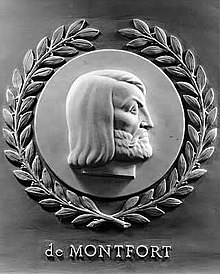 In August, 1265, Simon and his forces were defeated at the Battle of Evesham, and Simon himself was brutally slain and dismembered in reprisal for his rebellion. He is rightly considered a martyr for democracy.
In honor of the accomplishments of Simon V De Montfort toward democracy, a relief of him adorns the walls of the US House of Representatives.
Read more about his father Simon IV de Montfort and the Crusade against heresy in my novel Taking the Cross here (UK) or here (US).
Posted in Uncategorizedwith no comments yet.
The Crusades in Perspective

It seems the topic of the Crusades has come up a lot lately. Now that ISIS has invaded Libya, they have turned to threatening Italy, which is straight to the north of Libya. The terrorist group called Italy “the nation signed with the blood of the cross”, referring to the Crusades. The ISIS propaganda magazine Dabiq also had a cover photo of the ISIS flag flying over St. Peter’s Square in the Vatican. The headline read: “The Failed Crusade.”
ISIS is not only repeatedly referencing the Crusades in their propaganda, but seeking to return the lands they conquer to the Middle Ages. Their many barbaric acts include executing 21 Coptic Christians on a beach in Libya and burning a captured Jordanian pilot to death inside a cage.
President Obama recently commented on these events at the National Prayer Breakfast: “Lest we get on our high horse and think this is unique to some other place, remember that during the Crusades and the Inquisition, people committed terrible deeds in the name of Christ.”
Instead of helping to put events in context, the president is merely repeating the same myth which is uncritically accepted by so many people, that the Crusades were only unprovoked brutality against the Muslim world.
I do agree with the Inquisition being a stain on the history of Christianity. My novel, Taking the Cross, is about the Crusade against heresy in France that led to the Inquisition. That particular Crusade, which sought to suppress those considered heretics and religious freedom in general in Southern France, naturally morphed into the Inquistion.
The Inquisition, however, had nothing to do with the Muslim world. The Crusade in France that led to the Inquisition was also a far cry from the original mission of those who embarked on the First Crusade.
The Crusades as a whole are a mixed bag, yet have many more redeeming qualities than the Inquisition. The history of the current conflict with ISIS and Islamic terror did not begin or end with the Crusades. I want to say that at the outset I don’t have a particular need to defend every last aspect of the Crusades. Some of the Crusades went terribly awry at times, the best known example of which is the sacking of Jerusalem after it was conquered during the First Crusade. Yet certain events in isolation do not tell an entire story, however bad those events may be. The Crusades as a whole were primarily a defensive conflict. They were not about spreading Christianity at the point of a sword, but about defending Europe from invasion by Islamic Turks and Arabs. They were also about reclaiming territory which was once Christian and had been captured centuries before.
In other words, the Crusades were a long delayed European response to centuries of aggression in the name of Islam.
As I said before, the story does not begin with the Crusades. Rather it begins much earlier in the Arabian peninsula in the 7th century. During his lifetime, Muhummad and his followers conquered much of the Arabian peninsula. Over the next 100 years after his death, from the years 632 to 732, the armies of Islam conquered Jerusalem and the Holy Land, Syria, Egypt, swept all the way across North Africa, and up through Spain and Portugal and into France, coming within about 100 miles of Paris itself. These lands, from Syria to France, were all majority Christian in their population. The Christian (and all non-Muslim) people facing invasion of their lands had essentially 3 choices: 1. Convert to Islam, 2 Battle the invaders to the death, or 3. Accept 2nd class dhimmi status and a heavy religious tax and remain Christian. In this vein, the early spread of Islam, like ISIS today, is much closer in spirit to the Inquisition than to the Crusades. ISIS, in fact, seems intent on recreating the original Muslim conquests that led to the First Crusade.

In 732 the West finally mounted its first successful defense. A force of about 30,000 led by Charles Martel, better known as Carl the Hammer, clashed with a force of upwards of 80,000 led by Abd Al-Rahman near the city of Tours, France, about 100 miles southwest of Paris. The forces of Carl the Hammer, who was the father of Charlemagne, prevailed though they were likely outnumbered. The first Muslim push into Western Europe was stopped.
By the end of the 8th century, all of France had been freed from Muslim rule and the Moors pushed south back across the Pyrenees. The reconquest of Spain continued for many centuries until the last Moorish stronghold surrendered in 1492.
In other words, the majority of what is now the Muslim world was conquered and subdued by force (see the map above). It was this aggression, borne in the early days of Islam, that was unprovoked.
The Christian Byzantine Empire, which had already lost Asia Minor, Syria, the Holy Land, and Egypt to Muslim conquests, continued to come under siege. By the 11th century, the city of Constantinople was threatened again, this time by Turkish Muslim forces that had pushed across Asia Minor and were within 50 miles of Constantinople (which today is Istanbul). It was at this point, in the year 1095, Byzantine Emperor Alexius Comnenus appealed to Pope Urban II for help.
Urban responded by delivering a sermon in Clermont, France that same year in which he called for pilgrims to take the Cross to defend the Byzantine empire and recapture Byzantine lands, including Jerusalem itself: “The kingdom of the Greeks is now dismembered by [the Turks] and deprived of territory so vast in extent that it cannot be traversed in a march of two months. On whom therefore is the labor of avenging these wrongs and of recovering this territory incumbent, if not upon you?” This was the call for the First Crusade.
The response to Urban’s sermon was astounding. Though no kings responded to the call to take the Cross and go on pilgrimage, many knights and tens of thousands of common people from all over Europe responded, most at great expense and hardship to themselves. Few profited financially. For nearly all it was a great sacrifice. Tens of thousands never returned to Europe. Within 3 years the Turks had been pushed out of Asia Minor, within 4 years Jerusalem had been retaken.
The Crusades, in spite of disasters such as the Fourth Crusade, which was diverted from its mission to Egypt to attack Constantinople, kept the Muslim world on the defensive for 200 years.
The fact that ISIS and other groups are now threatening Italy and such places as the Mall of America in my home state of Minnesota, is evidence that Muslim forces did not succeed in conquering the West. It’s also evidence that many forces within the Muslim world still desire to do so.
It is also very likely that without the Crusades we would all now be under Sharia law.
Remember that Islamic conquests began with a single tribe in the Arabian peninsula. Will we allow history to repeat itself? Will we wait until ISIS is within 100 or within 50 miles from Paris, or New York, or the Twin Cities, before finally mounting an effective defense?
Posted in Uncategorizedwith no comments yet.
My Journey in 2014: Throwing my Bread on the Path or Casting it Upon the Waters?
2014 was the year my first novel was published. It was very exciting (triumphant music plays in the background).
It was also the year I jumped head first into the marketing and promotion fray. That was less exciting (dark, murky, slightly ominous music floats through the air). What I thought would be a pond or maybe a medium-sized lake of marketing at the most, has proven to be more like an ocean.
As I’ve tried to stir the waters to gather attention and buzz for my novel, at times it has felt like being out in the middle of the Pacific in a dinghy trying to stir the entire ocean with one oar in my hand.
After all, my novel is only one of literally millions of books that are available on Amazon and other sites.
I have received much good marketing advice and direction along the way. Still I found myself asking if I was scattering my bread on the path or on the surface of the waters.
What in the world does that mean you ask? I’ll try to explain.
Bread on the Path
We all know the story of Hansel and Gretel. Hansel leaves bread crumbs along the path. The bread is scattered so he and his sister can find their way home through the forest. But the birds eat it all and Hansel and Gretel are lost. Like Hansel, was I throwing my efforts on the ground, only to be consumed by crows and ravens?
Bread on the Waters
In the biblical book of Ecclesiastes it says to “cast your bread on the surface of the waters, for you will find it after many days”. I have scattered a lot of “breads” upon the waters. But what does that mean? The idea is to invest your efforts in many places for you do not know what will bring a return. The writer of Ecclesiastes, King Solomon, is not speaking of getting soggy, bloated bread in return for your efforts. But rather a reward of your efforts from an unexpected place. Some of your efforts will go into a void, never to come back to you. But some will return. You cast out many metaphorical “breads” because you do not know what will come back to you, what will succeed. It is an act of faith.
Some my “breads” have returned. Most are still out there. I can’t say for sure whether those were scattered on the path or on the water. Another writer told me to be patient with my marketing. Yet, there is a fine line between being patient and being passive.
In 2014 I was not seeking to get back home like Hansel, but to venture out into the world, to a place I had never been before. It was a stretch to say the least. Though I consider myself to be a good writer, I do not consider myself to be naturally gifted at either promotion in general or social media in particular, to say the least, though I am trying. If some people do social media like they are running through sunlit green fields with the wind at their back, I do social media like walking with a limp on a rutted path in a blustery thunderstorm against the wind. Some people seem to build a devoted following rather easily. They post that they like the color orange and that post receives 317 likes and 188 comments about the deeper meaning of the color orange, and others waxing eloquent about the beauty of sunsets. Ahh, the color orange. And that’s only in the first ten minutes of the post. Yet, maybe they work harder at it then I think they do.
It took me awhile to understand the “social” part in social media. Since my reason for getting on social media in the first place was to sell/promote my new novel, most of my postings consisted of variations on the theme of “buy my book”, “buy my book”, “buy my book”. By the way, did I mention I want you to buy my book? It’s really, really good. Sure I tried to do some witty and funny or intriguing posts or tweets or pins. Sometimes they were, I think, maybe. But it’s not my strength to churn out great social media stuff on a regular basis. Then I read a book about social media that talks about how many authors treat social media like it’s broadcast media, one-way communication, when social media is about two-way communication, building connections with people and not directly selling to them.
I have been a freelance writer for many years. But everything I wrote before my novel did not require any marketing. I wrote my story, received the promised payment and that was that. I did attend some very low-key book signing events as a contributing author for an inspirational book series, but that was to build connections and network with people. It was fun to sign a few books on the pages where my stories appeared, but I received no additional money as a result of those sales.
As soon as I reviewed the final manuscript from my publisher last summer and sent it back to him, it felt like a major loss of control. Within about 2 weeks of approving that final version my novel appeared on Amazon and was available at many Barnes & Noble stores. Things moved very fast. It was very exciting and very stressful. This work that I have spent 8 years crafting, that I once had total control over, was now out there. I had lost all control. I was very ambivalent about that. The good news and the bad news was that anyone could buy it, read it, and comment on it/review it/rate it however they wanted to.
Thankfully the first reviews by people who were not family or friends were very good (the reviews from family and friends were good too!).
After I received the first printed copies of my book and found out it was at Barnes & Noble, I was on a high for basically the whole month of August. In August, in addition to being on a high, I was also busy lining up events for September, and in September busy with the events I lined up in August and also busy lining up events for October. After the October events were over, things slowed down somewhat.
Since I also work full-time at a day job that has nothing to do with writing and selling novels, it’s a challenge to muster the time, energy and focus to market my novel and myself. I was told I needed to brand myself, not literally, but decide what image I wanted to project. I thought I just had to write a good maybe great novel and it would rise to the top like cream. What?! That’s not how it works? But isn’t it self-centered and self-focused to market yourself? Here I am! Pay attention to me! It’s all about how you do it of course.
I am still wrestling with it means to succeed.
I have a target of how many novels I need to sell before my publisher will release the second novel in the Taking the Cross series (it’s already written). I would have to sell many more novels beyond that to actually make a living at it.
My New Year’s resolution for my marketing is to shift my focus from trying to sell as many novels as I can in the short term, to focusing on building an audience for the long term.
That means I need to blog more than once a month.
Posted in Uncategorizedwith no comments yet.
Seeing Life as an Epic Quest
With the coming release this week of the final Hobbit movie, The Battle of the Five Armies, and the conclusion of Bilbo’s epic journey, I’ve been thinking about the idea of life being a quest.
Since the first Lord of the Rings movie, The Fellowship of the Ring, the release of the extended edition of either the Lord of the Rings or the Hobbit movies is always an event at our house. We are excited to watch not only the longer version of the movie itself, but also the appendices that tell the story of how the movies were made. The amount of creativity and artistry and hard work that goes into those movies is truly incredible. It could be said the making of each of the trilogies was an epic quest in and of itself.
But I would argue that epic quests are not limited to books and movies. In fact, I believe they are an attempt to define the experiences of our own lives. I think one of the main reasons for the enduring appeal of The Hobbit and The Lord of the Rings is the desire to find meaning on our own journey through life. We have all been through trials that test the soul. Whether we are aware of it or not, I think we want to know that our journey means something, that the trials we endure are advancing us toward a prize. Not a blue ribbon, but something of much deeper importance.
Stepping out on the quest is a leap of faith. Completing the quest is always harder than we ever imagined. Unlike Perceval searching for the Holy Grail, we don’t always know at first what our quest is about, or even that we are on a quest. We see through a glass darkly as St. Paul says in I Corinthians 13. But there are transformational moments along the way, where our demands that our circumstances change give way to change that happens within us. At times, we keep going only because we have become different people, not because anything around us has changed. In The Desolation of Smaug, Gandalf tells Bilbo that he is not same the hobbit he was when he left home. That is a good thing. In those moments, if we yield to the hand that is guiding us, we see that the quest will take all we have, and that it is worth pouring out all we are to reach the end.
And what is that end? What would the object of our quest be? Frodo’s quest was to destroy evil in the form of a ring. My favorite portion of literature that I have read is in The Return of the King when Frodo and Sam are journeying through the bleakness of Mordor to reach the mountain of fire. The one place where the ring can be destroyed. Their battle with despair is poignantly captured by Tolkien and is very moving. Anyone who completes a quest will have to overcome despair, and they cannot do it alone. Nearly all quests in literature are driven by redemption in some way. We make journey to restore that which was lost. The quest of Thorin was to restore the lost kingdom of Erebor. But there are always dragons to be battled along the way. The gold we ultimately seek is not physical but spiritual. The essence of an epic quest is to seek salvation, first for oneself and then for others. “I am the way, the truth, and the life.” Those words of Jesus are unambiguous. Yet the Bible says once we have salvation, that we walk out what that salvation means in our lives “with fear and trembling”. There is no 5-step plan or flowchart to get us there.
Such quests are not made for an age in which people check their cell phones or tablets 55 or 555 times a day. People who cannot unplug can be scattered people who lack the wholeness to focus on completing a quest. That can be each of us at times. Electronic devices are ultimately not the object of our quest any more than are other possessions or even books, though all are useful tools. Even the American dream itself is not ultimately about material things but about freedom, about salvation from tyranny.
Ultimately, however, what we need saving from is ourselves. In The Desolation of Smaug we saw the beginnings of Thorin becoming hostage to the very thing he thought would set him free. Liberation must come first to our souls. We cannot lead others to freedom unless we are first free.
With the coming release of The Battle of the Five Armies, an onscreen quest comes to an end. It is exciting but perhaps a little scary also. We find in fantasy and in history clearer examples of epic quests than we ourselves experience today. It does not mean that there are not epic quests today, far from it. It means that the path we must take is harder to find amidst the neon and the noise of our modern age. In the Psalms it says “be still and know that I am God.” Can we unplug and be still? Can we tolerate silence? Only then can we find the path we need to walk.
Posted in Uncategorizedwith no comments yet.
Eva the Beguine
One of the challenges I faced in writing Taking the Cross was my wish to have an independent female character. During the Middle Ages, women outside of the nobility had, for the most part, little freedom and little power. I knew when I started writing Taking the Cross that I wanted two main characters. Andreas would be a knight of some prominence. Eva would be a young woman of Provence.
I wanted Eva not to be tethered in any way. Women in the Middle Ages, and most women throughout history, were generally tied down in some fashion, whether to parents, to a husband, or to a religious order. My desire was that she would be a woman who was free to make choices about her life. If Eva was going to bind herself to a man, it would be out of her own choosing and not out of parental arrangement or economic necessity. But her ability to make decisions concerning the course of her life had to be rooted in historical reality, otherwise the novel moves away from historical fiction and into fantasy.
That is why I was surprised and delighted during the course of my early historical research to come across the Beguines. The Beguines were a movement that began in Flanders—what is now Belgium. The first communities of Beguines were established around 1180, about thirty years before Taking the Cross, which is set during the summer of 1209. The Beguines were the wives and daughters of the men who had been killed on Crusade.
The First Crusade was called for by Pope Urban II in 1095. By 1209 there had been four Crusades and tens of thousands of fathers and husbands slain in the Holy Land and the lands in between Jerusalem and Europe. A movement rose up in the late twelfth century among the widows and orphans of those men to form communities for mutual provision and protection.
Initially the Beguines received the permission and blessing of the Catholic Church. By the early thirteenth century, the movement had expanded outside of Flanders into other parts of Europe, including France. The Beguines did not have to take a lifelong vow, only a vow of celibacy, which they could break to enter the marriage bed. When we first meet Eva in the second chapter of Taking the Cross, she is a Beguine living in a community outside of Orange, France. Her father had been killed during the Third Crusade nearly twenty years before.
The Beguines had extraordinary freedom for women living during the Middle Ages. In his excellent book on the Beguines, called Cities of Ladies, Walter Simons writes that Beguines could earn their own income, could often read and write, and could even purchase land. In Taking the Cross, Eva has her own profession (she is a woodcarver). She is literate in three languages. She also owns her own lands just outside of the community of Beguines where she has a pear orchard. In short, she is highly educated and able to support herself. She is also able to postpone marriage, and has turned down many suitors as a result.
The result is a situation unprecedented for a woman in Medieval times, one that gives Eva’s character a broad range of possibilities. We know that even if she does end up pledging herself to Andreas, the other main character, she will do so by her own choosing.
Posted in Uncategorizedwith no comments yet.
The Languedoc
When most Americans think of places in France, they of think Paris, Normandy, Provence. Few seem to know of the Languedoc. Yet, if they have journeyed there, it is a place not easily forgotten. It not only has the largest intact Medieval walled city in Europe, but is the realm of the troubadours, of courtship and romance, and of the first crusade that was targeted against lands in Europe. Taking the Cross is set in the Languedoc and Provence during the first summer of this Crusade, which came to be known as the Albigensian Crusade against heresy.
The Languedoc is named for the language which used to be predominantly spoken there, a tongue called Occitan. It was the language of the troubadours and of those who lived in Southern France and Northern Spain during most of the Middle Ages. Occitan as a language is much closer to Spanish than to French. Before the Albigensian Crusade, the nobles of the Languedoc aligned themselves with King Pedro of Aragon, whose throne was in Barcelona. The name Languedoc comes from Langue d’oc, or the “language of yes”.
In the early thirteenth century, at a time when so much of Europe was issuing an emphatic “no”, the Languedoc said “yes”. Yes to greater freedom of religion, yes to increased economic freedom, yes to more freedom for Jews and not persecution. In June, 1209, the Languedoc was likely the most free and the most wealthy realm in Europe. The size of its great cities such as Beziers, Carcassonne, and Toulouse, rivaled or surpassed London, Paris, and Rome itself. Albigensians and Waldensians, groups that thrived in the Languedoc under protection, groups that either did not believe or did not practice their faith in the way of the Catholic Church, were deemed to be heretics.
Pope Innocent III declared heretics to be more evil than Saracens and launched the Albigensian Crusade. It ravaged a free and prosperous land. It led to the oppression and brutality of the Inquisition. C.S. Lewis declared that if not for the Albigensian Crusade, the Renaissance would have begun in the Languedoc in the thirteenth century two-hundred years before it began in Italy.
The largest intact Medieval walled city in Europe is Carcassonne. It is the Chateau Comtal, the castle of the city of Carcassonne, that is pictured on the cover of Taking the Cross. When I traveled to the Languedoc, I was able to go inside the Chateau Comtal, the castle of Viscount Raimon Roger Trencavel I, who is a main character in Taking the Cross. From the Chateau Comtal, I went to the nearby Tower of Heretics. It is so named because heretics were hanged there after the Albigensian Crusade from the crossbeams of the roof of the tower.
It was in the Tower of the Heretics that the history of the Languedoc came alive for me. As I stared up at the broad crossbeams, it was as if I could hear the screams and feel their suffering of those who were hanged, feel the heat and smell the smoke from those burnt at the stake. Even though it took my many years to figure it out, it was then I knew I had a story to tell. The first installment of that story is Taking the Cross.
Posted in Uncategorizedwith no comments yet.
Why Historical Fiction
One of my favorite authors is Stephen Lawhead. One of his fascinations is with Celtic lore, which he explores deeply in his Song of Albion trilogy. The first novel in the trilogy, however, The Paradise War, starts in the present day. Before encountering a portal that takes him into the past, the main character comments on how a digital clock is the perfect metaphor for the age we live in, because it provides instant information without context.
I think context is the reason why I love historical fiction so much. It’s the reason why I’ve written an historical novel, one that’s being released in August. So many people seem to accept things the way they are without questioning how we got here. I am a firm believer that we cannot understand the present if we don’t grasp the past.
A clock with an hour and a minute hand enables us to see where we’ve been in terms of time and also where we are going. Yet we have more information than ever before available to us in digital form with less context than ever before.
We should not live in the past, yet our lives are rooted in past events. Some things in the past may even need to be uprooted. Even in this we need to understand the past so we know which root to take hold of and yank out of the ground.
My novel, Taking the Cross, is about a period in history that saw the beginning of many movements that continue today.
Foremost among these are the freedom movements that were birthed during what is known as the High Middle Ages. In the popular imagination we don’t tend to associate anything Medieval with freedom. Yet the Albigensian Crusade was launched in 1209 against fiefdoms in Southern France whose lords gave some measure of religious freedom to their people. This led eventually to the Reformation and Renaissance. During the Middle Ages it became common law that peasants who could escape to the cities and support themselves for a year and a day could receive their freedom. What we know now as courtship and romance also started during the twelfth and thirteenth centuries. From troubadours seeking to romance the lady of the court eventually grew the idea that a man had the freedom to seek out and woo the woman he wanted as his wife, and she was free to choose which suitor she wanted.
Movements that laid out the framework for modern tyranny also started with the Albigensian Crusade, which spawned the Inquisition, the original thought police. People could be punished severely for merely holding or even sheltering those who held the wrong beliefs. The Inquisition itself continued for another four-hundred years, but we see much of the Inquisition in the totalitarian regimes of the twentieth and twenty-first centuries.
It is worth remembering that many of the freedoms we enjoy as Americans today are rooted in movements that started over eight-hundred years ago. It is in that context that we must remain vigilant to protect those freedoms, especially as we remember this Memorial Day those who gave their lives so that we can live in freedom.
Posted in Uncategorizedwith no comments yet.
The Value of Reading Actual Books
Reading is food for the mind. It stimulates the imagination and expands one’s vocabulary. It is a unique interaction between the reader and the words on the page, which are more than words. No book is the same for two different people. Reading the right book allows a person to escape to another world for a time and return and stand more solidly in this one. To see life around us more clearly.
One of the most revolutionary inventions in history was the printing press. It is what separated the ancient world from the modern one. For the first time, a book could be mass-produced accurately and cheaply. Reading, knowledge, became available to the masses. The printing press was the telegraph, the telephone, the internet of its time. It remains pertinent today. Hardcover books alone continue to outsell e-books, not to mention that paperbacks far outpace them both. That may change, but the power of crafting words into story will remain unaltered.
Studies have shown that watching television uses almost no brain power. Reading engages the mind, the soul. The reader must, in a sense, complete what the writer has started. Television and movies have their place. The Lord of the Rings trilogy brought Tolkien’s work alive.
Yet I think the best literature I have ever read is the journey of Frodo and Sam through Mordor and their battles with despair. No movie, no matter how good can capture that depth. Books can be a safer way to learn more of ourselves and honestly face our own struggles. Writing is also a legacy. One of my greatest motivations to continue writing Taking the Cross was being inspired by books written hundreds and even thousands of years past. By people long dead whose printed words continue to live on.
Posted in Uncategorizedwith no comments yet.